Showing posts with label england. Show all posts

Friday, April 23, 2010

Appealing for an English Parliament on Saint George’s Day


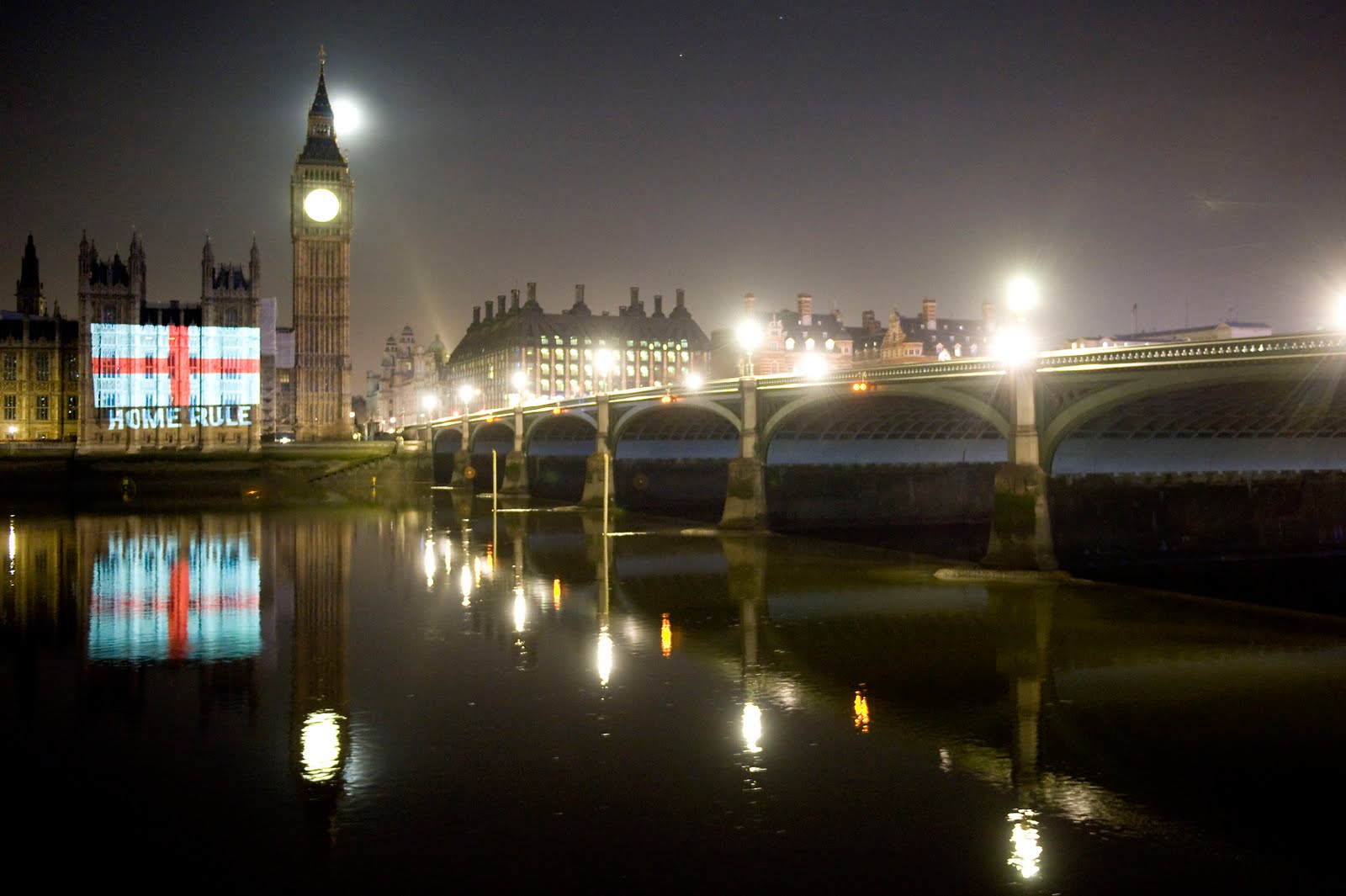
Today, the national day of England, Power 2010, a Rowntree-backed campaign group aiming at the reform of our political system and a fairer democracy, has released figures indicating that seven out of ten people now back a Parliament for England. The findings came as last night the movement staged a huge guerrilla-like projection of the Saint George’s Flag with the words ‘Home Rule’ on to the Palace of Westminster.

The poll, carried out by ICM, shows that 68% of voters in England believe that the country should have its own Parliament with similar powers to that of Scotland. In addition 70% of respondents said that English laws should be decided only by MPs representing English constituencies.

It’s worth stressing that this is about a perceived lack of fairness and democratic balance among ordinary voters, rather than Englishness as such. The poll of 1033 people across the country showed that almost half of the respondents feel “equally British or English.”

Pam Giddy, the Director of Power 2010, has rightly highlighted the fact England has not figured at all in the leaders’ debates, or in the campaign, though most people clearly want a fairer way of making decisions that affect their homeland. In a press release issued in the early hours of the morning she said;

It suddenly feels like we are on the cusp of seismic change to the way our politics is done. But so long as the unfair system we have at the moment persists it can only play into the hands of undemocratic voices like the BNP. With all the talk of reform in the air politicians should not duck the English question, but use the opportunity of Saint George’s Day to say where they stand.

For me there continues to be a certain degree of ambivalence here: on the one hand I do think that the Union has been greater than the sum of its parts, while on the other I toy more often with the idea of complete English independence. But what I am in no doubt about at all is that our present system is grossly unfair to the majority of the people who live in this kingdom, a point I made recently in England, it’s Time to Waken Up.

That piece also touched on the fact that the Conservative Party has committed itself to answering the West Lothian Question, and to that degree is in tune with and even one step ahead of the Power 2010 campaign. Still, I do not think that part of the Tory Manifesto is emphasised merely as much as it should be, especially as it would meet with such a receptive audience, given the evidence of this poll.

Wednesday, April 21, 2010

My Country


I Vow to Thee, My Country is arguably one of the greatest patriotic songs ever written, and would be my personal choice for an anthem for England. The words come from a poem by Sir Cecil Spring-Rice set to the music of Gustav Holst and published just after the First World War.

Nominally it’s a hymn, and is sung in church as such, but it’s really a paean to the great national sacrifice made during the War, an offering on the alter of the God of Battles, Mars himself. It’s for this reason that the second verse is now omitted. It’s even been called ‘heretical.’ But I would have it, and have it in all of its glory.

I vow to thee, my country, all earthly things above,
Entire and whole and perfect, the service of my love;
The love that asks no question, the love that stands the test,
That lays upon the altar the dearest and the best;
The love that never falters, the love that pays the price,
The love that makes undaunted the final sacrifice.

I heard my country calling, away across the sea,
Across the waste of waters she calls and calls to me.
Her sword is girded at her side, her helmet on her head,
And round her feet are lying the dying and the dead.
I hear the noise of battle, the thunder of her guns,
I haste to thee my mother, a son among thy sons.

And there's another country, I've heard of long ago,
Most dear to them that love her, most great to them that know;
We may not count her armies, we may not see her King;
Her fortress is a faithful heart, her pride is suffering;
And soul by soul and silently her shining bounds increase,
And her ways are ways of gentleness, and all her paths are peace.


Tuesday, March 16, 2010

Beyond the Pale; English Perceptions of the Irish


Negative English attitudes towards the Irish date as far back as the reign of Henry II. One could do no better here than examine the things written by the chronicler Gerald of Wales, who visited the island in the company of Prince John. As a result of this he wrote Topographia Hibernia (Topography of Ireland) and Expugnatio Hibernica (Conquest of Ireland), both of which remaind in circulation for centuries afterwards. Ireland, in his view, was rich; but the Irish were backwards and lazy;

They use their fields mostly for pasture. Little is cultivated and even less is sown. The problem here is not the quality of the soil but rather the lack of industry on the part of those who should cultivate it. This laziness means that the different types of minerals with which hidden veins of the earth are full are neither mined nor exploited in any way. They do not devote themselves to the manufacture of flax or wool, nor to the practice of any mechanical or mercantile act. Dedicated only to liesure and laziness, this is a truly barbarous people. They depend on their livelihhod for animals and they live like animals.

Gerald was not atypical; for one can find similar views in the writings of William of Malmesbury and William of Newburgh. When it comes to Irish marital and sexual customs Gerald is even more biting, "This is a filthy people, wallowing in vice. They indulge in incest, for example in marrying-or rather debauching-the wives of their dead brothers."

Even earlier than this Archbishop Anselm accused the Irish of 'wife swapping', "...exchanging their wives as freely as other men exchange their horses." You will find these views echoed centuries later in the words of Sir Henry Sidney, twice Lord Deputy during the reign of Elizabeth I, and in those of Edmund Tremayne, his secretary. In Tremayne's view the Irish "commit whoredom, hold no wedlock, ravish, steal and commit all abomination without scruple of conscience." In A View of the Present State of Ireland, published in 1596, Edmund Spencer wrote "They are all papists by profession but in the same so blindingly and brutishly informed that you would rather think them atheists or infidels."


This vision of the barbarous Irish, largely born out of a form of imperialist condescension, made its way into Laudabiliter, one of the most infamous documents in all of Irish History, by which Adrian IV, the only English Pope, granted Ireland to Henry II, "...to the end that the foul customs of that country may be abolished and the barbarous nation, Christian in name only, may through your care assume the beauty of good morals."


All and every method was to be used in this 'civilizing mission' over time. In 1305 when Piers Bermingham cut off the heads of thirty members of the O'Connor clan and sent them to Dublin he was awarded with a financial bonus. His action was also celebrated in verse. In 1317 one Irish chronicler was of the view that it was just as easy for an Englishman to kill an Irishman as he would a dog. Later when the English control of Ireland shrunk back for a time to The Pale around Dublin, all beyond was considered as given over to savagery, hence the expression 'Beyond the Pale'.


What we see here is the same thing that appears time and again, throughout the whole world, and over all time: it begins when an entire community is condemned as barbarous; it ends with the justification of all and every method in the creation of 'civilization', no matter how barbarous. It is against this background that one must place the Cromwellian Conquest and all that followed, in both Hell and in Connaught

Wednesday, February 17, 2010

English Votes on English Laws


I am English, by birth, by outlook, by attitude, by instinct; I live, breathe and think England; I love England, love its history, its culture, its people. Yes, I am English but I also love the idea of a greater nation, of Great Britain, as the sixteenth century Scottish historian John Major or Mair once defined it. The Union of England, Wales, Scotland and Northern Ireland is so much greater than the parts.

Over the past three hundred years Britain has brought so much to the world, in peace and in war. England has benefited immeasurably from the Celtic contribution, just as the Celtic nations, though they may no longer like to admit it, have achieved significance in the world far beyond their immediate power and reach. So, yes, I am English but I am also British. It worries me, then, to see SS Great Britain in danger; in danger of sailing on to a particularly pernicious reef. It's called, mundanely enough, the West Lothian Question, long since posed but never answered. Some of you will know it but for those who do not it goes like this:

For how long will English constituencies and English Honourable members tolerate...Honourable Members from Scotland, Wales and Northern Ireland exercising an important, and probably often decisive, effect on English politics while they themselves have no say in the same matters in Scotland, Wales and Northern Ireland?

In its original form it was posed over thirty years ago by Tam Dayell, then Labour MP for the West Lothian constituency, in a debate on devolution in the House of Commons. Well, we now have devolution. Northern Ireland once again is almost completely self-governing; Scotland has a Parliament and Wales an Assembly, with powers over domestic matters...and the West Lothian question has still not been answered.

Irish, Welsh and Scottish MPs still come to Westminster. Irish, Scottish and Welsh MPs can vote on matters pertaining to England alone, while English MPs have no say in the domestic politics of the Celtic nations. We have in Gordon Brown and Alistair Darling a Prime Minister and a Chancellor, both Scots, who can formulate policy and vote on English domestic matters, while English MPs are powerless over matters affecting the constituencies these men come from.

None of this might matter but for one thing: Labour has in the past depended on the support of Scottish and Welsh MPs to achieve a majority in the House of Commons at Westminster. This was irksome, yes, but tolerable within a national framework, tolerable when the reverse process applied: when the Conservatives ruled in Wales and Scotland because they had a majority in England. But it is intolerable in the context of devolution. If, as may very well happen, and perhaps in the not too distant future, a Labour government, with a minority of MPs in England, is propped up by Celtic votes, then the Union will be in real and immediate danger. The English are a tolerant people, but there are limits even to their toleration.

For this reason, and because I want the Union to survive, the time has come to set right the injustice embedded in the West Lothian Question; the time has come to ensure that only English votes are allowed in the passing of English Laws. For this reason I give my wholehearted support to an internet petition on this very matter.

If you care at all for England, for justice and for the Union I would urge you to register your own vote. If the campaign receives enough support it will form part of the Power2010 pledge, and that will mean that Power2010 will lobby every prospective MP to pledge to introduce English Votes on English Laws in the next Parliament.

Let's answer the West Lothian question; let’s end this insult to democracy, let’s end this danger to the union. If you are English, even if you are Scots, Welsh or Irish I would urge you to register a vote in favour of this proposal. http://www.power2010.org.uk/votes/entry/english-votes-on-english-laws

Tuesday, October 13, 2009

What England Means to Me


What follows is an essay I wrote for a site dedicated to this question (www.whatenglandmeanstome.co.uk) It really should be preserved here also.

I find it so difficult sometimes to define what it means to be myself let alone tackle questions of this weight! What does England mean to me, what does it mean to be English? Why, I suppose it’s a little bit like a reflex, a little like breathing: English is what I am; English is what I will always be.

For me it’s not about sport, or politics or any transitory passion; it really does rest on something altogether deeper. I love the English language, a love the beauty and the rhythm of simple English prose. Yes, I know the language is not exclusively ours any longer. It’s been launched into the world sometimes with uncertain-and unhappy-returns! But I would continue to look for Englishness, Englishness expressed through words, in what I like to call the original ‘mines’ of our language, our poetry and our literature. There they are before me: Langland and Chaucer; the Bible, both in William Tyndale’s translation and in the King James’ version; the Book of Common Prayer; the plays and poetry of Shakespeare, the Jacobean poets and more.

I’ve been working my way through The Collected Essays, Journalism and Letters of George Orwell. He’s a super writer, a true craftsman, expressing himself in simple, limpid prose. In England Your England part of a longer essay entitled The Lion and the Unicorn he analyses at some length what exactly it means to be English. Yes, a lot has changed since 1940 but a lot remains remarkably the same. The individuality is still there, the dislike of regimentation and officialdom, the suspicion of ‘ideology’ as something foreign, something un-English. These were the rocks against which Fascism and Communism floundered. It’s these same qualities that continue to make English people distrustful of identity cards or the European Super State ; of standardisation in any form.

I have no hesitation whatsoever in saying that the English, with all of their idiosyncrasies, all of their baffling eccentricities, are simply beyond the comprehension of most foreigners. Karl Marx spent most of his life in this country in exile. Always expecting great things from the English proletariat, the most advanced in Europe, by the lights of his theory, he came to see that England was the one country in Europe with a bourgeois aristocracy and a bourgeois working class as well as a bourgeois bourgeois! His last recorded words were “To the Devil with the British.”

Britishness? Ah, yes, now there is a problem. I grew up believing simply that Britishness and Englishness were more or less the same thing though I was very well aware that the Celtic nations had a separate and somewhat prickly identity. It’s been their assertiveness, their determination to be ‘themselves’, to govern themselves, that resulted in our present botched constitutional settlement, one that has really forced me to focus more specifically on simple Englishness. I no longer use British to identify myself other than to say that I have a British passport.

Yes, our present constitutional settlement is botched, badly thought-out and unfinished. It has raised more questions than it has answered, the question over England’s political sovereignty above all, our right to manage our own domestic affairs without outside interference, interference by those who are not English. Where does England fit in the devolved United Kingdom ? I simply don’t know. There is, so far as I can tell, no great desire for a separate English parliament, but things cannot go on as they are indefinitely. It’s a house of cards which will fall, I believe, if we ever again have a Labour administration only kept in place by MPs from Scotland and Wales.

Sovereignty also raises the question of our position within the European Union. This is a touchy subject because I see considerable dangers in the current integrationist drift in European policy, dangers in the Lisbon Treaty for our future liberty. If we ever do become Airstrip One it will be largely thanks to the efforts of our own politicians, arguably more damaging than those of Philip II, Napoleon or Hitler.

I’m sure it comes no surprise that I’m a history student. And it is English history, our common heritage, which I believe defines us as a nation in the fullest sense. Our pride, our individuality, our idiosyncrasies, our distrust of foreign ideas and, yes, of foreigners, has largely been determined by our island story, by a slow evolution of a common culture. I simply refuse to accept that there is a single English person, admit it or not, who does no feel a stirring of the blood when hearing the great St Crispin’s Day speech from Henry V. It most assuredly stirs my blood, as does the speech of Elizabeth I at Tilbury. That’s Englishness, a dogged courage in the face of terrible odds. That’s my England.